

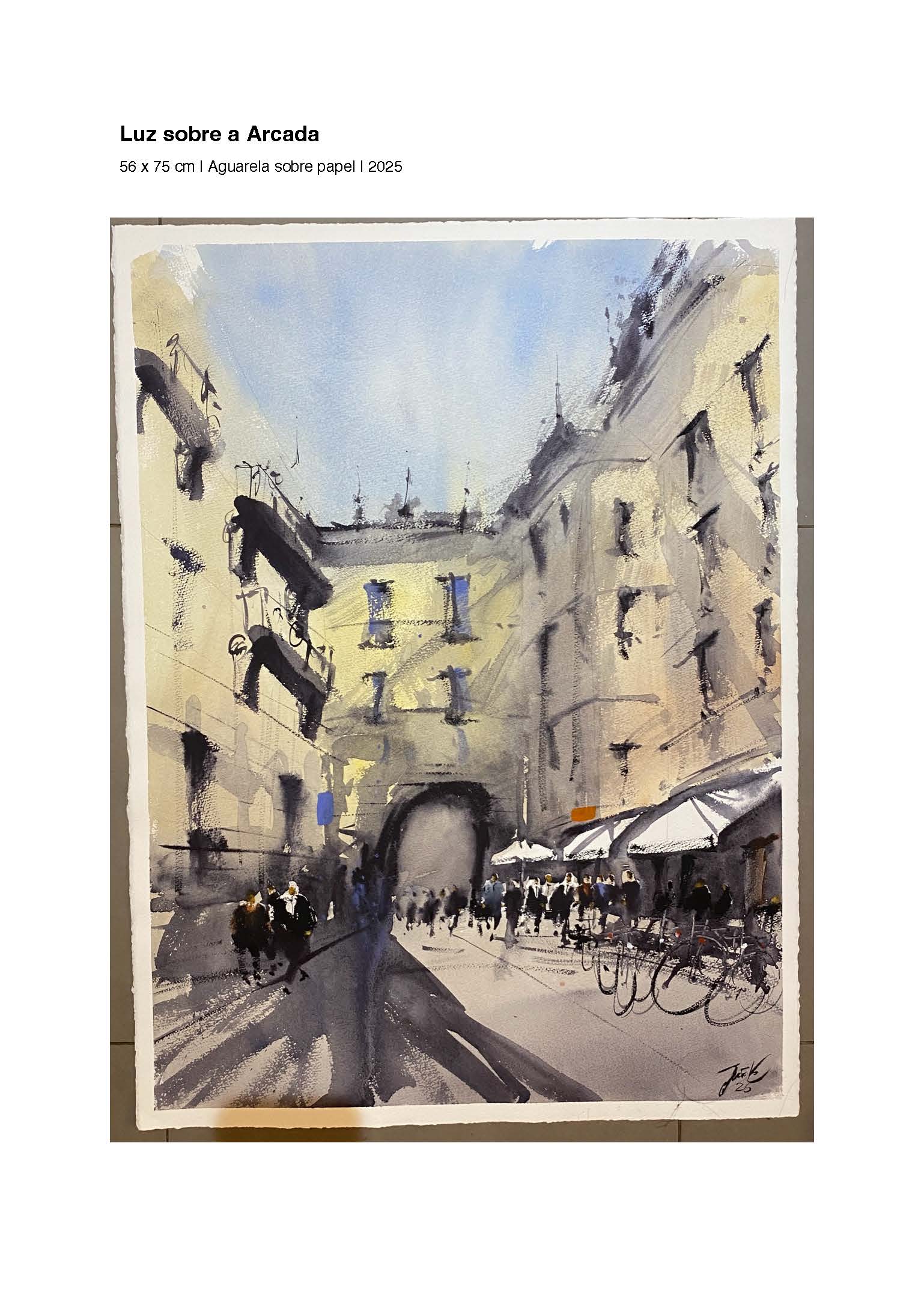
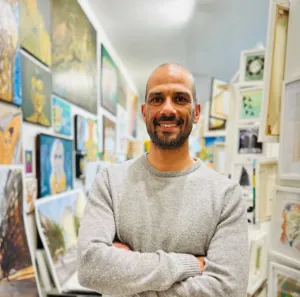
João Casanova is a Lisbon-based visual artist whose practice centres on painting and watercolour, exploring urban environments through gesture, rhythm, and atmospheric perception. His work moves beyond literal representation, focusing instead on the emotional and sensory resonance of cities, their fleeting light, silences, and traces of lived experience.
Casanova began his artistic training at Escola Artística António Arroio, where he developed a strong foundation in the visual arts. He later stepped away from painting to pursue higher education in Dance, a formative period that deeply shaped his understanding of the body, movement, and temporality. This embodied awareness has since become central to his pictorial language, where painting functions as a graphic record of gesture and motion.
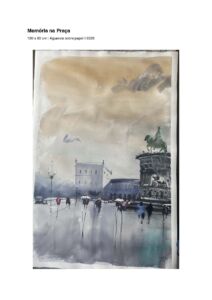
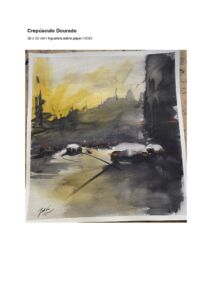
Working primarily with watercolour, Casanova privileges expressive brushwork and strong contrasts, allowing suggestion to carry greater weight than detail. His compositions translate urban atmospheres into fluid, rhythmic marks that echo the cadence of movement and the pulse of the city.
He has participated in several group exhibitions in Portugal and internationally, including at Galeria 23A (Lisbon), Espacio Gallery (London), and exhibitions with the Nuno Gama Collection. His work has also been shown in Mescla at Galeria Municipal Verney and Meninências at Arteinvitica, Porto. Alongside his exhibition practice, Casanova produces commissioned works for private collectors.
CURATORIAL STATEMENT — Joana Rousseau
João Casanova’s work operates at the intersection of painting and movement. His practice is deeply informed by the body, not as subject, but as method. Gesture is not illustrative; it is structural. Each brushstroke carries rhythm, tempo, and intention, functioning as a residue of movement rather than a depiction of form.
His watercolours do not aim to document the city as a fixed place. Instead, they register its emotional charge, the pauses between motion, the tension between presence and absence. Urban space becomes a field of sensations, translated through contrast, fluidity, and restraint.
Casanova’s background in dance introduces a heightened awareness of time and corporeality into his painting. Marks unfold as sequences rather than static gestures, allowing rhythm to guide composition. This approach results in works where atmosphere outweighs description, and where the city emerges as a lived, felt environment rather than a mapped one.
Within his practice, painting becomes an act of listening, to movement, to space, to the quiet poetry embedded in everyday urban experience.